Why Amish Font Stands Out Among Handwritten Script Fonts
When you are searching for a font that feels both personal and bold, handwritten script fonts often come to mind. Among them, Amish and the Amish font family has gained attention for its thick, marker-inspired character. Unlike many digital typefaces that aim for perfect uniformity, Amish brings a raw, hand-drawn quality that can transform a design from ordinary to memorable. But is it the right choice for your project? This article explores what makes Amish distinct, how it compares to other handwritten script options, and the practical tradeoffs you should consider before committing to it.
What Makes Amish Font Distinct?
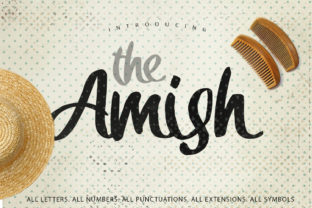
Amish is not a subtle font. It is a thick marker handwritten script that carries a deliberate, almost deliberate roughness. Each letterform feels as though it was drawn with a broad-tipped marker on paper, with slight inconsistencies in stroke weight and spacing that give it an authentic, human touch. This lack of digital perfection is precisely its strength.
Key characteristics include:
- Thick, bold strokes that command attention even at smaller sizes.
- Handwritten irregularity that avoids looking mechanical or sterile.
- Marker texture that mimics real ink on paper, adding warmth.
- Playful yet readable letterforms that retain legibility despite the casual style.
These traits make Amish well-suited for projects where you want to communicate authenticity, creativity, or a handmade feel. However, the same qualities can become limitations in more formal or dense applications.
Comparing Amish with Other Handwritten Script Styles
Handwritten script fonts cover a wide spectrum, from elegant calligraphy to casual brush lettering. Understanding where Amish fits within this landscape helps you evaluate it against alternatives.
Amish vs. Fine Calligraphy Scripts
Calligraphy scripts are typically refined, with varying stroke thicknesses created by a nib or brush. They often convey elegance, tradition, and sophistication. Amish, by contrast, is thicker, more uniform in weight, and deliberately rough. If your project requires a wedding invitation or formal certificate, a calligraphy script may serve you better. Amish would feel out of place in those contexts, as it leans toward playfulness rather than formality.
Best fit for Amish: Casual branding, children's materials, informal signage.
Alternative when you need: Elegance, delicate flourishes, or traditional formality.
Amish vs. Modern Brush Scripts
Brush scripts are another popular category, characterized by varying stroke widths and a sense of speed. They feel energetic and contemporary. While Amish shares the hand-drawn quality, its strokes are less varied and more consistent in thickness. This makes Amish more stable and easier to read at smaller sizes, but less dynamic than a brush script.
If your design needs a sense of motion or a trendy feel, a brush script might work better. If you want something sturdy, friendly, and straightforward without being boring, Amish holds its ground.
Tradeoff: Amish offers reliability over drama. You trade some visual excitement for steadiness and legibility.
Amish vs. Casual Handwritten Fonts
Many casual handwritten fonts aim for a "drawn on a napkin" look. Amish differs because of its marker thickness. It feels more substantial and less delicate than many casual scripts. It sits at the intersection between playful and bold, making it more versatile for headlines and short text blocks.
If you need a font that can scale up to a poster or down to a badge without losing character, Amish handles both reasonably well. Thinner handwritten scripts might become hard to read at small sizes, while Amish retains its bold presence.
Strengths of Amish Font in Practice
Understanding the strengths of Amish helps you recognize where it adds value. Here are the most notable advantages:
- High legibility at small sizes: Thick strokes and simple letterforms reduce ambiguity, even when scaled down.
- Strong personality without being distracting: It carries a distinct voice but does not overwhelm the content.
- Works well in short bursts: Headlines, titles, pull quotes, and call-to-action buttons benefit from its bold, friendly nature.
- Pairs easily with simple sans-serif fonts: Amish complements neutral typefaces, allowing you to create contrast without clashing.
- Feels approachable and human: In an era of digital perfection, a font with slight imperfections can build trust and relatability.
For example, a small business selling handmade products might use Amish for product labels or social media graphics. The font reinforces the handmade quality of the products. A children's book cover could also benefit from its playful yet readable style.
Limitations and When to Choose Another Option
No font is universally perfect. Amish has clear limitations that you should consider before using it in your project.
Limited Suitability for Long Body Text
Amish is a display font, not a text font. Its thick strokes and casual irregularity make it tiring to read in long paragraphs. If your project includes extended reading, such as blog posts, articles, or reports, reserve Amish for headings and accents. Use a clean, neutral font for the body text to maintain readability.
Practical example: A restaurant menu could use Amish for the restaurant name and section headers, but the dish descriptions should remain in a simpler, lighter typeface.
Potential Legibility Issues in Complex Layouts
Because Amish is thick and dense, it can become muddled when placed over busy backgrounds or used in tight letter-spacing. Fine details in the marker texture may also get lost in very small sizes or low-resolution displays. Test the font at the actual size and medium you plan to use before finalizing.
Not Ideal for Formal or Professional Contexts
If you are designing a corporate report, legal document, or anything requiring a neutral, authoritative tone, Amish is not the right choice. Its casual, handwritten nature can undermine the seriousness of the message. In those cases, a clean sans-serif or classic serif is more appropriate.
Decision Factors: How to Choose Wisely
When evaluating whether Amish fits your project, consider these questions:
- What is the tone of your project? Friendly, creative, casual, and approachable tones align well with Amish. Formal, technical, or luxury tones may not.
- Where will the font appear? For headlines, short text blocks, and accent elements, Amish works beautifully. For long paragraphs, look elsewhere.
- Who is your audience? Children, creative professionals, small business owners, and audiences who value authenticity may respond positively. Corporate stakeholders may not.
- What medium are you using? Amish prints well and appears on screens without issues, but test it at the intended size. Marker texture may look different on coated vs. uncoated paper.
- Does the font complement your other design elements? Pair Amish with simple, clean fonts and avoid competing textures or patterns in the background.
Practical Examples and Comparisons
Let us look at a few realistic scenarios to see how Amish performs alongside alternatives.
Scenario 1: A Coffee Shop Menu Board
You want a font that feels warm, local, and handmade. Amish works well for the shop name and drink categories. The bold strokes are visible from a distance, and the marker texture suggests a handwritten chalkboard feel. A thin calligraphy script might be too delicate for this context, while a brush script could feel too trendy. Amish hits a comfortable middle ground.
Scenario 2: A Digital Product Mockup
You are designing a mockup for a handmade soap brand. The product name uses Amish, and the description uses a clean sans-serif. The pairing creates a clear hierarchy: the font draws attention to the brand name while the body remains easy to read. A casual handwritten font with thinner strokes might not stand out as effectively.
Scenario 3: A Corporate Newsletter
Here, Amish would likely feel out of place. The casual, hand-drawn style does not match the professional tone expected in corporate communication. A standard sans-serif or a refined serif would be more appropriate. If you still want a handwritten touch, consider a more polished script with cleaner lines.
Making an Informed Decision
Choosing a font is rarely about finding the "best" option in absolute terms. It is about finding the right fit for your specific context, audience, and goals. Amish and the Amish font family offer a distinctive thick marker handwritten style that can bring warmth, personality, and approachability to your designs. But it is not a universal solution.
When you need a font that feels handcrafted, bold, and friendly, Amish is a strong contender. When you need elegance, formality, or extended readability, you should consider other options. The key is to match the font's personality with your project's purpose.
Take the time to test Amish in your actual layout, at the sizes you intend to use, and with the other design elements in place. That practical testing will reveal whether the font serves your project effectively or whether an alternative would be a better fit.
By understanding both the strengths and limitations of Amish, you can make a confident choice that supports your design goals without relying on hype or assumptions.