Handding: A Strategic Choice for Distinctive Brand Communication
Every decision you make about typography carries weight. The fonts you choose do not merely decorate your message—they shape how that message is received, remembered, and acted upon. Handding and Handding Two offer something that goes beyond conventional typeface selection. These are fully hand-drawn, all-uppercase script fonts that bring a deliberate human quality to your work. When used with intention, they can support goals that range from brand differentiation to clearer communication, from creative productivity to stronger customer recall. The key lies not in using them randomly, but in understanding when, why, and how they serve your broader objectives.
What Handding Actually Offers
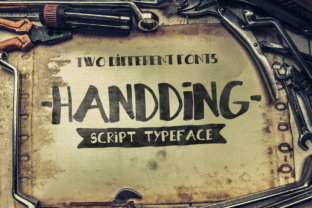
Most script fonts try to simulate handwriting. Handding and Handding Two are handwriting. Every character has been drawn by hand, not generated by algorithm or assembled from modular components. That distinction matters because it introduces an organic inconsistency—slight variations in stroke weight, baseline drift, and character spacing that no digital automation can replicate convincingly. The fact that both fonts are all-uppercase is also significant. It removes the guesswork of capitalization rules and forces a uniform visual weight, which can be leveraged for headlines, short calls to action, logotype treatments, and any context where you need a phrase to command attention without competing with surrounding lowercase forms.
Handding Two extends the family with additional character options and alternate glyphs, giving you more room to vary the look while staying within the same stylistic world. For someone who plans their communication carefully, that extra flexibility can be the difference between a one-off design and a cohesive system that works across multiple touchpoints.
Why Thoughtful Typography Supports Better Decision-Making
Typography is rarely the first thing people consider when they plan a campaign, build a brand, or develop content. Yet it is often the first thing an audience notices, even if subconsciously. The decision to use a hand-drawn script font like Handding is not merely aesthetic—it is a strategic signal. It tells your audience that this piece was crafted, not assembled. It suggests care, individuality, and a human presence behind the message.
For entrepreneurs and small business owners, that signal can be particularly valuable. In a marketplace where many competitors rely on generic templates and safe system fonts, a deliberate typographic choice helps you stand out without saying a word. It sets the tone before the first sentence is read. If your goal is to build a brand that feels personal, approachable, or artisanal, then a font like Handding can become part of your positioning from the start.
Marketing professionals and content creators can also use this to their advantage. When you need to break through a crowded feed, email inbox, or store shelf, a headline set in Handding carries a different weight than one set in a standard sans-serif. It feels less corporate, more immediate, and more connected to the person behind the message. That can improve engagement metrics, but more importantly, it can improve the quality of the connection you build with your audience.
Strategic Use Cases for Handding and Handding Two
Not every project benefits from a hand-drawn script font. Knowing where these fonts shine helps you deploy them with purpose rather than impulse. Here are several contexts where Handding and Handding Two can support your broader goals.
Brand Identity and Logo Treatments
A logotype set in Handding immediately communicates that the brand values craftsmanship and personality. This works especially well for creative professionals, boutique service providers, product-based businesses with a handmade angle, and personal brands where the founder is central to the offering. Because the font is all-uppercase, it reads as confident and bold, but the hand-drawn quality softens that boldness into something approachable.
Headlines and Section Titles
When you need a section of your website, brochure, or presentation to stop the reader, Handding can serve as a visual anchor. Use it sparingly—perhaps for the main headline on a landing page or for key section titles inside a longer document. The contrast between a hand-drawn script and cleaner body text creates a natural hierarchy that guides the reader through your content.
Product Packaging and Labels
For physical products, especially those in food, beverage, wellness, or craft categories, packaging is often the first and only chance to make an impression. A label set in Handding can suggest small-batch quality, artisanal methods, and a human touch. Handding Two gives you additional glyphs to avoid repetition across a product line, which matters when you are scaling from a single product to a range.
Social Media Graphics and Short Messages
Social platforms are saturated with content. A quote, announcement, or call to action set in Handding can stand out in a feed where most text is rendered in platform defaults or standard display fonts. The uppercase nature also helps with legibility at small sizes, which is critical on mobile screens.
Event and Invitation Design
Whether digital or print, invitations benefit from a personal feel. Handding works well for event titles, dates, and key details where you want to evoke a sense of occasion without resorting to ornate or overly decorative typefaces that can feel dated. The hand-drawn quality suggests the event itself has been put together with care.
Planning Your Approach: What to Consider Before You Commit
Using Handding effectively requires thinking ahead. Here are strategic considerations that can help you decide whether this font fits your current project or long-term plan.
- Audience expectations. A hand-drawn script font resonates differently depending on your audience. It may feel authentic and warm to one group and informal or unpolished to another. Test your context. If you serve corporate clients or highly professional industries, use Handding sparingly and in supportive roles rather than primary branding.
- Readability at scale. All-uppercase script fonts can become difficult to read in long passages. Handding is best reserved for short phrases, headlines, and emphasized text. For body copy, choose a complementary neutral font that provides contrast and comfort for extended reading.
- Consistency across media. If you plan to use Handding across print, web, video, and signage, test how it renders in each medium. Some hand-drawn fonts lose detail at small sizes or on low-resolution screens. Confirm that your chosen weight and size remain legible where they matter most.
- Alternate glyphs and variation. Handding Two exists precisely to address the risk of repetition. If you need to use the font repeatedly across a single project—such as a product line, a multi-page document, or a suite of social templates—varying the glyphs keeps the output fresh and avoids the mechanical look that can arise when the same characters appear too often.
- Pairing with other elements. Handding is assertive. It works best when paired with restrained supporting elements: clean sans-serif or serif body text, ample whitespace, and simple layouts. The font itself supplies the personality; everything else should let it breathe.
How Thoughtful Use of Handding Can Support Your Long-Term Goals
When you integrate a font like Handding into your communication toolkit intentionally, you are making a statement about how you operate. You are signaling that you pay attention to details, that you value human craft over automated convenience, and that you understand the difference between simply appearing different and being meaningfully distinctive. Over time, those signals accumulate. They become part of how people remember you, refer you, and recognize your work.
For educators and freelancers, this is particularly relevant. Your reputation is built on trust and personal connection. Using a hand-drawn font in your materials can reinforce that you are approachable, that you invest effort, and that your work is not mass-produced. For publishers and bloggers, it can help create a visual identity that sticks with readers across posts and platforms. For decision-makers in any organization, choosing a distinctive typeface like Handding is a small but visible way to challenge the default and demonstrate that your team thinks about presentation as part of the value you deliver.
Risks of Using Handding Without Clear Intent
Like any design choice, Handding carries risks if applied without purpose. The most common mistake is using a hand-drawn font in contexts where it undermines credibility. If your audience expects professionalism, precision, or formality, an all-uppercase script may feel out of place. Another risk is overuse. When every headline, subhead, and call to action is set in the same hand-drawn style, the effect becomes noise rather than emphasis. The font loses its power to signal importance because it no longer stands out from its surroundings.
There is also a risk of inconsistency. If your brand or project uses Handding in some places and unrelated fonts in others without a clear system, the result feels disjointed. Audiences notice when visual language changes without logic. That inconsistency erodes trust and makes your work feel less intentional than it actually is.
Finally, avoid the trap of assuming that a hand-drawn font alone makes your work feel authentic. Authenticity comes from the substance of your message and the alignment between your visual choices and your actual values. A font can support that alignment, but it cannot create it. If your content is generic, your service impersonal, or your product mass-produced, no font will convince people otherwise. Handding works best when it reflects something true about how you operate.
Making the Decision: Who Should Use Handding and When
Handding and Handding Two are tools, not solutions. They serve you best when you already have clarity about what you want to communicate and who you want to reach. If your goal is to create a brand or project that feels personal, crafted, and human, these fonts deserve serious consideration. If your priority is efficiency, scale, or corporate uniformity, they may be better left for specific accents rather than primary use.
For the entrepreneur launching a new brand, the creator building a visual identity from scratch, or the marketer refreshing a campaign that needs more warmth, Handding offers a practical path to differentiation. The key is to approach it as a strategic element, not a decorative afterthought. Plan where it will appear, test how it reads at different sizes, and pair it with complementary typefaces that let it do its job without competing for attention.
Used thoughtfully, Handding can elevate your communication in ways that feel natural and earned. That is the real value of a hand-drawn font—not the novelty of the strokes themselves, but the message they send about the care behind the work.