AZ Placid: Understanding the Rough Outline Font and Its Role in Modern Design
Typography is rarely just about readability. It carries mood, texture, and personality in ways that often go unnoticed by casual viewers but resonate deeply with those who work with type every day. Among the more distinctive categories to emerge in recent years, rough outline fonts hold a special place. They sit somewhere between hand-drawn imperfection and intentional structure. AZ Placid is one such typeface that embodies this balance with remarkable clarity, offering designers a tool that feels both raw and deliberate.
Rough outline fonts, as the name suggests, feature edges that are not perfectly smooth. Instead, they mimic the natural irregularity of ink bleeding into paper, chalk wearing down on a board, or a marker running out of ink. AZ Placid takes this concept further by pairing the rough texture with an open, airy structure. The result is a font that feels approachable, unpolished in a curated way, and deeply human. Unlike many display fonts that scream for attention, AZ Placid whispers with quiet confidence.
What Makes AZ Placid a Rough Outline Font?
To understand AZ Placid, it helps to first understand what a rough outline font is designed to do. Standard fonts prioritize clean lines and consistent stroke widths. That consistency is valuable for body text and formal applications, but it can feel sterile in contexts where warmth or authenticity is needed. Rough outline fonts break away from that precision. They introduce variation, imperfection, and a sense of handmade quality.
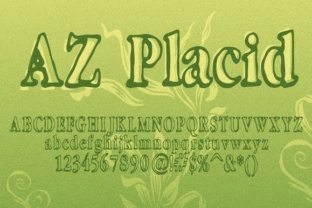
AZ Placid belongs to this category because its letterforms are constructed with an outline rather than a solid fill. The inside of each character remains open, while the outer edge carries the rough, distressed quality. This dual characteristic gives the font a lightweight, almost ethereal presence on the page. It does not dominate a composition the way a bold slab serif might. Instead, it leaves room for other visual elements to breathe while still asserting its own identity.
The roughness in AZ Placid is not random. It is measured and consistent across the character set. Every curve, serif, and terminal carries the same level of texture. That consistency is what separates a well-crafted rough font from something that simply looks broken or sloppy. Designers working with AZ Placid can trust that the rough quality will remain cohesive across headlines, quotes, and short-form text applications.
Texture That Feels Physical
One of the first things you notice about AZ Placid is how tactile it feels. Even on a screen, the font evokes the texture of printed matter. The rough edges suggest contact with paper, ink, or maybe even a block print. This quality makes it especially useful for projects that want to communicate a sense of craftsmanship, tradition, or authenticity. A brand selling handmade goods, artisanal food products, or vintage apparel might find AZ Placid to be a natural fit.
Open Letterforms for Versatility
The outline structure of AZ Placid means that each letter has a large internal space. This openness makes the font surprisingly legible despite its rough edges. Many rough fonts sacrifice readability for aesthetic effect, but AZ Placid manages to maintain clarity because the outlines are clean even when the edges are rough. The internal voids are generous, and the spacing between letters is well calibrated. You can use it at larger display sizes and still read it without strain.
Weight and Balance
AZ Placid strikes a careful balance between being too heavy and too light. Because it is an outline font, it naturally appears lighter than solid typefaces. But the rough edges add visual weight that prevents it from feeling flimsy. This balance makes it suitable for a range of applications, from packaging and posters to social media graphics and website headers. It can hold its own against other visual elements without overwhelming them.
Where AZ Placid Fits Into Modern Workflows
Typography choices are never made in isolation. They are part of a larger design system that includes color, imagery, layout, and brand voice. AZ Placid integrates well into workflows that prioritize authenticity and a human touch. It is not the font you reach for when designing a corporate annual report or a financial dashboard. But for projects that need warmth, personality, and a sense of the hand, it becomes an invaluable tool.
Branding and Identity Projects
Brands that want to stand out in crowded markets often turn to typography as a differentiator. AZ Placid works especially well for logos, wordmarks, and brand collateral where the goal is to convey approachability and craftsmanship. Imagine a small-batch coffee roaster using AZ Placid on their bags, or a boutique soap maker using it for their labels. The rough outline quality suggests something made by hand, not by machine. That association is powerful in a world where consumers increasingly value authenticity.
Editorial and Print Design
In print, AZ Placid shines when used as a display font for headings, pull quotes, or section openers. It creates contrast when paired with a clean, minimal sans-serif for body text. The rough texture draws the eye and signals a shift in tone or emphasis. Magazines, zines, and art books often use fonts like AZ Placid to add visual interest without resorting to heavy decoration. The font itself becomes a design element, not just a carrier of text.
Digital Design and Social Media
Using a rough outline font online can be tricky because screen rendering tends to favor clean, sharp edges. But AZ Placid handles this environment well because its texture is not overly fine or detailed. It reads clearly on screens, especially at medium to large sizes. Social media graphics, YouTube thumbnails, and website hero sections can all benefit from the font's distinctive look. It adds a layer of personality that is hard to achieve with standard web fonts.
Practical Benefits and Considerations
Before adopting AZ Placid into a project, there are a few practical factors worth considering. No typeface is perfect for every situation, and rough outline fonts have specific strengths and limitations that designers should understand.
Legibility at Small Sizes
Because AZ Placid is an outline font with rough edges, it is not ideal for body text. The openness of the letters helps, but at very small sizes, the rough edges can blend together and reduce clarity. This is a common limitation for rough and display fonts. The best practice is to use AZ Placid at sizes above 24 points for print and above 30 pixels for digital. Below those thresholds, the texture becomes less predictable and legibility suffers.
Pairing With Other Fonts
AZ Placid pairs well with simple, neutral typefaces. A clean sans-serif like Helvetica, Inter, or Open Sans provides a strong contrast to the rough organic quality of AZ Placid. Serif fonts can also work, but they need to be restrained to avoid competing for attention. The goal is to let AZ Placid be the star while the supporting font handles body copy and secondary information. Overloading a page with multiple rough or decorative fonts usually leads to visual chaos.
Color and Background Considerations
The outline nature of AZ Placid means that color choices matter more than they might for a solid font. A dark outline on a light background yields the highest contrast and best readability. But the font also works beautifully as a reverse out, with the outline rendered in white over a dark or textured background. Because the letters are open, the background color shows through the interior, which can create interesting layering effects. Designers can use this to their advantage by placing AZ Placid over photographs, gradients, or patterns.
Common Questions Designers Ask Before Adopting AZ Placid
When encountering a font like AZ Placid for the first time, designers often wonder about its versatility, file format support, and long-term usability. These are reasonable concerns. A font that looks great in a specimen might not perform well across all the contexts where you need to use it.
AZ Placid is available in standard formats including OTF, TTF, and WOFF, which means it works across print and digital platforms. It supports a full character set including numerals, punctuation, and accented characters for multiple languages. The rough texture is built into the font file, so there is no need for additional effects or filters to achieve the look. This makes it predictable and easy to implement.
Another consideration is how the font ages over time. Some rough fonts feel trendy and quickly become dated. AZ Placid avoids this because its design is rooted in timeless block print and letterpress traditions rather than fleeting digital trends. It has a classic quality that will likely remain relevant as long as designers value authenticity and texture in their work.
Scenarios Where AZ Placid Excels
Let me walk through a few concrete scenarios where AZ Placid would be an excellent choice and where it might fall short, so you can gauge whether it fits your specific needs.
Imagine you are designing a beer label for a microbrewery that prides itself on traditional brewing methods. The client wants something that feels old-world but not stuffy. AZ Placid in a muted gold on a dark navy background instantly communicates heritage, craftsmanship, and a modern sensibility. The rough edges echo the texture of a wooden barrel or a chalkboard menu. That is a natural fit.
Now imagine the same font used for a legal document or a medical brochure. The rough outline would undermine the seriousness and clarity those contexts require. It would feel out of place, even unprofessional. That is not a weakness of the font. It is a reminder that typeface selection always depends on context, audience, and purpose.
E-commerce product pages can also benefit from AZ Placid when used selectively. A heading that says "Handcrafted with Care" in a rough outline font carries more emotional weight than the same phrase in a standard sans-serif. The font reinforces the message through its very appearance. That is the kind of synergy that elevates good design to great design.
Final Observations on AZ Placid
AZ Placid occupies a specific niche in the typographic landscape, but it fills that niche with purpose and polish. It is not a font for every project, and it does not try to be. What it offers is a distinctive voice that is hard to replicate with other typefaces. For designers who value texture, authenticity, and a human touch, AZ Placid provides a reliable way to bring those qualities into their work.
The rough outline style will continue to appeal to brands and creators who want to stand apart from the polished, sanitized aesthetic that dominates so much of modern visual culture. AZ Placid makes that statement without shouting. Its roughness is not a flaw. It is the feature that gives the font its character and its reason for existing.
When you are working on a project that needs warmth, history, or a sense of the handmade, consider reaching for AZ Placid. It handles the heavy lifting of creating mood and connection through typography, leaving you free to focus on the rest of the design.