Yellow Child: An Honest Evaluation of This Handmade Brush Font
When selecting a typeface for a project, the choice often comes down to balancing aesthetic appeal with practical functionality. Yellow Child is a handmade brush font that has gained attention for its elegant, organic look. But like any design tool, it comes with specific strengths and limitations that matter depending on your use case. This article provides a balanced evaluation to help you decide whether Yellow Child aligns with your goals.
What Is Yellow Child?
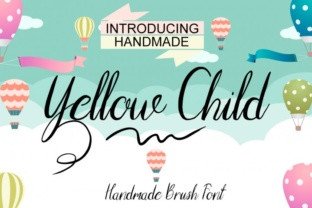
Yellow Child is a display font designed to mimic the fluid strokes of a brush. Its letterforms are crafted by hand, giving each character subtle variations in weight, angle, and texture. The result is a typeface that feels personal and artistic rather than mechanically uniform. It falls into the category of brush script fonts, but its elegance sets it apart from more casual or rough alternatives. The font includes uppercase and lowercase letters, numerals, and basic punctuation, making it suitable for short-form typography.
Unlike many modern brush fonts that rely on perfectly smooth curves, Yellow Child retains a tactile quality. The edges are slightly irregular, and the strokes taper naturally, as if written with a real brush dipped in ink. This handmade character is its defining feature and the primary reason designers are drawn to it for projects that require warmth and authenticity.
Why Consider Yellow Child?
The main appeal of Yellow Child lies in its ability to convey a specific tone. If your project needs a friendly, approachable, yet refined atmosphere, this font can deliver that without overwhelming the design. It is particularly effective for headlines, logos, and other display applications where the type itself becomes a visual element.
Another reason to consider it is its versatility. Despite being a brush font, Yellow Child is not excessively ornate. It strikes a balance between being decorative and readable, which allows it to work across different contexts—from wedding invitations to product packaging. Many users also appreciate that it is designed as a single-weight font, which simplifies pairing decisions when combined with other typefaces.
Typical Use Cases
- Branding and logos: Small businesses, artisan brands, or creative studios often choose Yellow Child to reflect a handmade or boutique identity.
- Event invitations: Its elegance suits weddings, baby showers, and other celebrations where the tone should be warm and personal.
- Book covers: Particularly for fiction, poetry, or children’s books, the font can add a storytelling feel to the cover.
- Social media graphics: Short quotes, announcements, and titles benefit from its organic appearance in digital feeds.
- Printed collateral: Flyers, postcards, and stationery often use brush fonts to break away from corporate aesthetics.
Benefits of Choosing Yellow Child
One of the most significant benefits is the authenticity it brings. In a world of mass-produced design, a handmade font like Yellow Child helps a brand or project stand out by feeling human-crafted. Each letter's slight imperfections add character that a standard sans-serif or serif cannot replicate.
Another practical benefit is its legibility at medium to large sizes. While brush fonts can sometimes be illegible when scaled down, Yellow Child maintains clarity in headlines and subheadings. This makes it less risky for designers who are new to using brush typefaces.
Additionally, the font is relatively easy to implement in both print and digital formats. It comes in common file types such as .otf and .ttf, and it works well with design software like Adobe Illustrator, Photoshop, Canva, and others. Some versions may also include OpenType features like stylistic alternates or ligatures, which can add further variety to your text.
Tradeoffs and Considerations
No typeface is perfect for every situation, and Yellow Child has limitations worth understanding before you commit.
Legibility at Small Sizes
Like many brush fonts, Yellow Child is not designed for body text. When used at small point sizes—below 14–16 points—the intricate brush strokes can blur together, especially in digital environments. This makes it unsuitable for paragraphs, captions, or any context where long reading is required.
Character Set and Language Support
Some handmade fonts have limited language support. Yellow Child typically covers basic Latin characters (A–Z, a–z, 0–9, and common punctuation). If your project requires accented characters (e.g., for French, German, Spanish, Portuguese) or special symbols, you should verify that the version you’re considering includes them. Without full language support, the font may not be practical for international audiences.
Licensing Restrictions
License terms vary depending on where you obtain the font. Some versions of Yellow Child are free for personal use but require a commercial license for branding, merchandise, or business applications. Always check the license agreement before using it in client work or for-profit projects. Using a font without proper licensing can lead to legal issues or unexpected costs later.
Uniformity vs. Handmade Variation
While the handmade quality is a strength, it can also be a limitation. The slight variations in stroke weight and shape mean that repeating the same word multiple times may look slightly different each time. For logos or text that must be perfectly consistent across all media, this variation might be undesirable. In such cases, a more standardized script font could be a better fit.
When Yellow Child Is a Strong Fit
Choose Yellow Child when your project needs a personal, artistic touch and the text will be displayed prominently. It works particularly well for:
- Startups or small businesses aiming for a creative, non-corporate identity.
- Event materials where the tone is celebratory, romantic, or playful.
- Artistic publications, such as zines, poetry books, or exhibition catalogs.
- Digital content where the font is used sparingly for emphasis, such as quote cards or call-to-action buttons.
- Children’s products, because the name “Yellow Child” and its approachable aesthetic align with youth-oriented branding.
If you want the viewer to feel that a human hand was involved in the design, Yellow Child delivers that message effectively.
When Alternatives May Be Worth Considering
Despite its strengths, Yellow Child may not be the best choice in several scenarios.
Formal or Corporate Contexts
For official documents, corporate reports, legal contracts, or medical publications, a brush font would look out of place and reduce professionalism. In such cases, a clean serif (like Times New Roman or Georgia) or a neutral sans-serif (like Helvetica or Open Sans) would be more appropriate.
Long-Form Text
If your project involves extended reading—blog posts, articles, books (beyond covers)—Yellow Child should not be used for the body. Its uneven stroke widths and decorative terminals will tire the reader’s eyes. You can still use it for headings, but pair it with a highly legible reading font for the main content.
Rapid Reproduction or System Fonts
For web use, some brush fonts may not render well on older browsers or mobile devices, especially if not properly embedded. If performance and cross-platform consistency are top priorities, you might consider a standard web-safe font or a more robust variable font.
Need for Multiple Weights
Yellow Child is typically available as a single weight. If your design requires contrast between bold and regular text, or if you need a condensed or expanded version, you will have to look for a font family that offers those variations. Alternatives like “Butterfly” or “Honey Script” (both brush script fonts) often come with multiple weights and styles.
Practical Decision-Making Insights
To determine if Yellow Child is right for your project, consider the following framework:
- Define your primary use: Is the text a headline, short callout, or decorative element? If yes, proceed. If it’s body text, stop—use a different font for that purpose.
- Assess audience expectations: Does your audience respond well to handmade, organic design? For example, a craft brewery or a boutique bakery audience would probably appreciate it; a financial advisory firm’s audience would not.
- Test readability at intended size: Print a sample at the actual size and medium (paper, screen, signage). If the text becomes fuzzy or the letters blend, increase the size or choose a different font.
- Check licensing early: Before you invest time in design, confirm the license covers your intended use (commercial vs. personal, number of projects, etc.). This avoids rework later.
- Plan for pairing: Yellow Child pairs well with neutral sans-serifs like Lato, Montserrat, or Roboto for body text, and with simple serifs for a more traditional look. Avoid pairing it with another complex display font.
- Evaluate alternatives: Compare Yellow Child to at least two other brush fonts. Look at samples of “Billion Stars,” “Sunday Morning,” or “Witching Hour” to see if any better match your brand’s personality or technical requirements.
Remember, the goal is not to find the “best” font universally, but the best font for your specific context. Handmade fonts like Yellow Child shine when the project’s tone values creativity over conformity.
Helping You Decide
To summarize, Yellow Child is an elegant handmade brush font that can add warmth and personality to logos, invitations, book covers, and other display-oriented materials. Its benefits include authentic texture, good legibility at medium to large sizes, and versatility across many creative projects. However, it also comes with tradeoffs: limited suitability for body text, potential language support gaps, licensing considerations, and lack of multiple weights.
If your project calls for a friendly, artistic, and non-mechanical appearance, and you are using the font for short, prominent text, Yellow Child is a strong candidate. If you need a font for long reading, formal contexts, or precise uniformity across multiple media, you should explore alternatives that offer broader functionality.
Ultimately, the best way to evaluate a font is to see it in action. Download a trial version (if available), create a mockup of your actual project, and assess how it feels. The right typeface should not only look beautiful but also serve the communication purpose without compromise. Yellow Child deserves a place in your typography toolbox, but like any tool, its value depends on using it for the right job.