Dominique: The Handwritten Font That Brings Personality Back to Design
There is something quietly magnetic about a font that doesn't try to be perfect. In a world saturated with crisp, geometric typefaces and hyper-polished sans serifs, the slightly uneven, human quality of a well-made handwritten font can stop a reader mid-scroll. Dominique, created by the talented Dominique Demetz, is exactly that kind of typeface. It feels less like a font and more like a note passed across a table, a postcard scribbled in haste, or a sign painted by a friend. It wields a rare combination of clarity and character, and that is a harder trick to pull off than it looks.
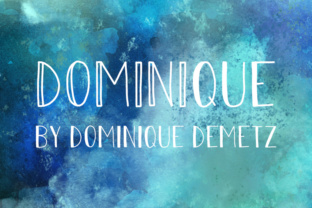
The first thing you notice about Dominique is the wobble. Those letters don't stand at stiff attention. They lean, they curve, they vary in height and width in ways that feel organic rather than random. This is not a font born from mathematical precision but from actual handwriting, captured and refined into a usable digital tool. The result is a typeface that feels alive, as if each letter was drawn by hand just for the project you are working on. That personal touch is precisely what so many designers, small business owners, and content creators are hungry for right now.
Who Is Dominique Demetz and Why Does That Matter?
The name behind the font is not just a brand. Dominique Demetz is a designer with a clear sensibility: work should feel approachable without sacrificing craft. When you use a font that carries the designer's own name, there is an implicit promise of care and attention to detail. Demetz did not simply digitize a handwriting sample and call it a day. The letters in Dominique have been shaped to work together as a cohesive system while still retaining the spontaneous charm of real handwriting. That balance is difficult to achieve. Too much uniformity kills the handmade effect. Too little structure makes the text unreadable. Dominique walks that line beautifully.
Knowing the designer's intent also helps you use the font more effectively. Because Demetz designed Dominique with headlines in mind, you can trust it to perform at larger sizes. The wobbliness, which might become distracting in body text, becomes an asset when the letters have room to breathe. It is a font that asks to be seen, not just read.
Readability Meets Whimsy: The Design Paradox Solved
Many handwritten fonts sacrifice legibility in the name of charm. Loops become tangled, descenders crash into ascenders, and the reader has to work too hard to decode each word. Dominique sidesteps this trap almost entirely. The letters are clearly formed. Each character has a distinct silhouette, so there is no confusion between an n and an r, or a v and a u. The x-height is generous, and the open counters keep the letterforms airy even when set tight.
This clarity makes Dominique an excellent choice for headlines, banners, and short-form display text. You can use it on a poster, a website hero section, a product label, or a social media graphic, and people will read it without hesitation. The wobble adds warmth, but it does not get in the way of communication. For anyone who has ever squinted at an overly stylized script and given up halfway through the sentence, Dominique is a relief. It proves that a font can be both playful and practical.
Where the Wobble Works Best
The uneven baseline and varied letter heights are not imperfections. They are features that create rhythm and texture. When you set a headline in Dominique, the words feel spoken rather than printed. There is a cadence to the text that mimics natural speech patterns. This is why the font works so well in contexts where you want to convey authenticity, approachability, or a handmade ethos.
- Branding for creative businesses: Bakeries, florists, illustrators, and boutique shops all benefit from a typeface that feels personal. Dominique says "we are small, we care, we made this ourselves" without you having to say a word.
- Social media content: In a feed full of templated posts and stock photography, a headline set in Dominique immediately stands out as human. It invites a double take.
- Invitations and stationery: Whether digital or printed, the font brings a hand-lettered quality that feels intimate. Wedding invitations, save-the-dates, and event flyers all gain warmth from its use.
- Product packaging: A jar of honey, a candle, a box of tea. Slap a Dominique label on it and suddenly the product feels artisanal, even if it was produced at scale.
Pairing Dominique with Other Typefaces
A font this distinctive does not work well in isolation for long. You will likely want to pair Dominique with something more restrained to create contrast and hierarchy. Because the handwritten forms are so expressive, they pair naturally with clean, neutral typefaces. A simple sans serif like Lato, Open Sans, or Montserrat sits quietly beside Dominique, letting the handwriting take the lead. You can also pair it with a classic serif for a more traditional, elegant feel, though this works best when the serif has a lighter weight so it does not compete visually.
The key is restraint. Let Dominique carry the emotional weight of the design. Use it for the main headline, the call to action, the most important line. Then let a simpler typeface handle the supporting text, the body copy, the fine print. This division of labor respects the font's strengths and prevents visual overload.
Sizing and Spacing Considerations
Because Dominique has that natural wobbly baseline, you need to give it room. Tight tracking (letter spacing) will cause the letters to fight each other, especially if there are tall ascenders or deep descenders. Loosen the tracking just slightly, and the font breathes. For headlines, a tracking value of 25 to 50 (in most design software) is a good starting point. For larger display sizes, you can even go looser. The goal is to let each letter hold its own space without losing the flow of the word.
Line height matters too. In longer headlines that wrap onto two or more lines, generous leading prevents the wobble from creating visual collisions between rows. If you set a two-line headline too tight, the descenders from the top line might graze the ascenders of the bottom line, and the effect goes from charming to messy. A little extra vertical space solves this cleanly.
Modern Workflows and Digital Applications
Dominique fits naturally into modern design workflows. It works across print and digital media without losing its character. On the web, it can be used as a webfont, provided you have the appropriate license. Its readability at headline sizes makes it effective for blog titles, landing page headers, and even navigation labels if used sparingly. In video, you can use it for lower thirds, title cards, or callout text, especially in projects that aim for a friendly, approachable tone.
For digital designers, one practical consideration is the font's performance on smaller screens. While Dominique is clear at large sizes, it is not designed for long body copy on mobile devices. Reserve it for short, impactful text snippets, and let a more traditional font carry the reading load. This is not a limitation. It is a strategic choice that ensures your design stays readable and visually effective across all devices.
Common Questions People Ask Before Choosing Dominique
If you are considering Dominique for a project, you likely have a few concerns. Let me address the most common ones.
Is it suitable for professional branding? Absolutely, provided the brand identity calls for a handmade, personal feel. It works wonderfully for creative fields, lifestyle brands, and artisan products. For more corporate contexts, use it sparingly as an accent rather than a primary typeface.
Will it look good in black and white? Yes. Dominique does not rely on color or texture to be effective. Its letterforms carry the personality, so monochrome applications like print flyers, black-on-white packaging, or grayscale social graphics still retain the font's warmth.
Can I use it for larger blocks of text? Not recommended. The wobble that makes it charming in headlines becomes fatiguing in longer paragraphs. Stick to short bursts of text: a few words, a single sentence, or a short tagline. That is where the font shines.
Does it support multiple languages? The standard character set covers most Western European languages, but you should check the specific font file for extended characters if you need accents or special glyphs for a particular language.
Final Thoughts on a Font That Feels Like a Person
The best fonts disappear into the message. They do not call attention to themselves; they simply make the words feel right. Dominique achieves this in a way that few handwritten fonts do. It is legible enough to be taken seriously, yet loose enough to feel human. It carries the personality of its creator, Dominique Demetz, while leaving room for your own voice to come through. Whether you are designing a logo for a friend's bakery, a header for a personal blog, or a label for a product you poured your heart into, Dominique gives you a head start. It already feels like someone cared. And that feeling, in a world of automated design and generic templates, is worth holding onto.