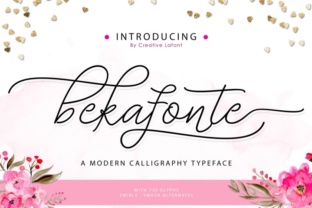
Bekafonte: A Hand-Drawn Font That Deserves Better Than Common Missteps
There is a quiet confidence in a font that looks like it was drawn by hand rather than plotted by machine. Bekafonte, along with its companion style Bekante, offers exactly that: a warm, slightly imperfect letterform that brings personality to any project. Unlike rigid sans-serifs or overly decorative scripts, Bekafonte strikes a balance between approachable and refined. It is the kind of typeface you reach for when you want to communicate warmth without sacrificing polish. But even a well-crafted font can fall flat if used carelessly. Many people pick it up, love how it looks in the preview, and then quickly run into the same issues: the swashes overwhelm the layout, the alternates feel mismatched, or the overall effect looks forced rather than elegant. The difference between a design that feels effortlessly personal and one that looks like a mistake often comes down to a few simple choices. Let us walk through those choices together so you can use Bekafonte with confidence.
Mistaking Abundance for Freedom
The first and most common error people make with Bekafonte is treating every alternate and swash as something that must be used. The font arrives with a generous set of stylistic alternates, ligatures, and swash caps. That can feel like a gift, but it can also lead to a layout where every letter seems to be competing for attention. When too many swashes appear in a single word or line, readability drops and the design begins to feel cluttered rather than elegant.
A better approach is restraint. Use swashes sparingly, perhaps only on the first or last letter of a headline, or on a single word that carries emotional weight. Alternates should be chosen with the same care. Pick one or two letters that benefit from a flourish and leave the rest in their standard form. This creates a rhythm in the text that feels intentional. The viewer does not notice the restraint, they only feel the result: a design that is polished and warm without being loud.
- Common mistake: Applying swashes to every capital letter in a word.
- What happens: The word becomes difficult to read and the elegance turns into chaos.
- Better choice: Limit swashes to one or two letters per word or phrase.
Another overlooked detail is the size at which you apply these features. Swashes that look graceful at 72 points can appear awkward and heavy at 24 points. Always preview your text at the actual output size before finalizing the design.
Ignoring Context and Medium
Bekafonte is often chosen for wedding invitations, thank-you cards, logos for boutique brands, or social media graphics that need a personal touch. These are all appropriate uses, but the mistake comes when people assume it works well everywhere. A hand-drawn font with alternates can feel out of place in a professional report, a technical manual, or any setting where clarity and neutrality are expected.
It is also worth checking how the font behaves on different screens and print surfaces. Some thin strokes in the swashes may disappear at small sizes on low-resolution screens, or bleed together when printed on uncoated paper. Always test Bekafonte in the medium where it will appear most often. If you are designing for digital use, check the rendering at several sizes and on different devices. If you are printing, request a physical proof or print a sample yourself before committing to a large run.
A better approach is to use Bekafonte for the parts of a design that need emphasis and warmth, while pairing it with a simpler, more neutral font for body text or secondary information. This contrast lets the hand-drawn quality stand out without overwhelming the entire message.
Neglecting Font Pairing Basics
Bekafonte has a distinct personality, and that personality needs a partner that complements it rather than competes with it. A common mistake is pairing it with another highly decorative font, hoping the extra style adds depth. In most cases, this creates visual noise. Two fonts with strong personalities tend to argue with each other rather than work together.
What works better: Choose a clean, simple sans-serif for body copy, captions, or supporting text. A font like Open Sans, Lato, or even a classic geometric sans such as Montserrat will allow Bekafonte to take the lead without distraction. For print projects, a subtle serif like EB Garamond or Cormorant can offer a nice contrast while still feeling traditional. The key is to ensure the secondary font stays out of the way so the hand-drawn elegance of Bekafonte remains the focal point.
Another oversight is not considering spacing and alignment between the paired fonts. Because Bekafonte has generous curves and swashes, it may need extra margin or padding to avoid colliding with adjacent text. Adjust the tracking and leading of the secondary font to create a consistent visual flow.
Overlooking Licensing and Source Quality
Because Bekafonte is popular, it shows up on many font download sites, not all of which are authorized distributors. Downloading from an unverified source can lead to several problems: the font may be incomplete, missing the alternates and swashes that make it special, or it may contain malware. Even if you get a working file, using an unlicensed version for commercial projects puts you at legal risk.
Before you download or buy, confirm the following:
- You are purchasing or downloading from the original foundry or an authorized reseller.
- The license covers your intended use (personal vs. commercial, digital vs. print, number of users, etc.).
- The font file includes all advertised alternates, swashes, and ligatures.
- You have access to support or updates if something goes wrong.
Spending a little more upfront on a legitimate license saves time, frustration, and potential legal headaches later. It also ensures you have access to the full feature set, which is essential if you plan to use the alternates and swashes as intended.
Misjudging Readability for Longer Text
Bekafonte shines in headlines, logos, short phrases, and callouts. Where it struggles is in longer paragraphs or dense text blocks. The hand-drawn quality that makes it charming in small doses can become tiring to read across several sentences. This is not a flaw in the font itself, but a misunderstanding of its best use.
A practical correction: Reserve Bekafonte for short, meaningful content. Headlines, pull quotes, product names, and signature lines are ideal. If you need to include a longer description or a supporting paragraph, switch to a neutral companion font. This respects both the font’s strengths and your audience’s comfort. Your readers will appreciate the visual variety without feeling fatigued.
When you do use Bekafonte for shorter text, pay attention to line height and letter spacing. Because the letters have organic shapes, a little extra space between lines can improve readability significantly. Avoid compressing the font or forcing it into tight layouts where the swashes start to overlap.
Failing to Test Before Committing
It is easy to fall in love with a font in a preview window and then import it into a project only to discover it does not behave as expected. The alternates may not activate automatically. The swashes may appear only in certain software. The spacing may look different once the text is placed inside a shape or alongside an image.
Before you finalize any design, perform these checks:
- Open the font in your design software and type a sample phrase that reflects your actual content length.
- Test the stylistic alternates and swashes to ensure they work with your software version. Some programs require manual access through the OpenType panel.
- Review the font at the actual output size and on the intended medium (screen, print, or both).
- Show the design to someone unfamiliar with it and ask if anything looks awkward or unclear.
This small investment of time prevents last-minute surprises and helps you deliver a polished result on the first try.
Letting the Font Overpower the Message
Hand-drawn fonts carry emotion. They remind us of handwritten notes, custom lettering, and personal care. That is precisely why Bekafonte is so appealing. But the emotional weight of the font can sometimes overshadow the actual message. A wedding invitation that uses too many swashes and alternates may end up looking like it is trying too hard, distracting from the warmth of the sentiment itself.
The solution is to let the font serve the message, not the other way around. Write your text first, then decide where the font can add emphasis. If a phrase feels meaningful, let it stand out with a single swash or an alternate letter. If the text is practical, keep it simple. The goal is not to show off the font, it is to use the font to make the message more genuine.
When you approach Bekafonte this way, the result is a design that feels both intentional and effortless. The person who receives your work may not say, “What a lovely typeface,” but they will feel the care that went into it. And that is the real purpose of any font with personality: helping you communicate not just words, but a sense of thoughtfulness.
What to Check Before You Use Bekafonte
If you are considering using Bekafonte for an upcoming project, take a moment to review these points before you begin:
- Your software: Make sure it supports OpenType features so you can access alternates and swashes.
- Your medium: Print or screen, large format or small, the font will behave differently in each context.
- Your audience: Will they respond to a hand-drawn style? Is the setting appropriate for a decorative font?
- Your license: Do you have permission for the specific use case you have in mind?
- Your pairings: Have you selected a simple secondary font that will not compete with Bekafonte?
- Your restraint: Are you using the alternates and swashes intentionally, or just because they are available?
Bekafonte and Bekante offer a rare combination of warmth and elegance that can elevate a wide range of projects when used well. The font itself is generous, but the best results come from selective use, careful pairing, and a clear understanding of the medium and message. By avoiding the common mistakes outlined here, you can ensure your design feels personal without feeling overdone, and elegant without being inaccessible.