The Craft of Badegan Script: A Handmade Calligraphy Font with Modern Versatility
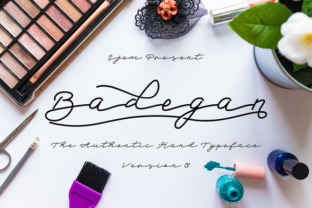
Typography often walks a line between consistency and character. While many digital fonts aim for mechanical perfection, Badegan Script takes a different path—one rooted in the irregularities of hand-drawn lettering. This handmade calligraphy script font carries a modern fresh style that feels both deliberate and spontaneous. Its dancing baseline, ornamental details, and extensive glyph set position it as a tool for designers who want warmth, movement, and personality in their work.
Understanding what makes a script font truly functional goes beyond aesthetics. Badegan Script is not just a set of alphabet characters—it is a system of variation. With 377 glyphs and multiple alternate forms, the font offers flexibility while retaining the cohesive rhythm of handwriting. Let’s explore what this means for different users, from stationery designers to branding professionals, and how the font’s structural choices affect real-world projects.
The Anatomy of a Dancing Baseline
One of the most distinctive characteristics of Badegan Script is its dancing baseline. Unlike rigid typefaces where every character sits on a flat horizontal line, this font allows letters to rise and fall naturally. This creates a visual flow that mimics the pressure and speed of a hand holding a pen. For greeting cards, wedding invitations, or personal notes, this movement adds emotional resonance—the text feels alive rather than typeset.
The dancing baseline also introduces a challenge: it demands careful spacing and composition. A designer working with Badegan Script must consider how each word interacts with the one above or below it. In headlines or short phrases, the effect is charming and elegant. In dense paragraphs, however, the same movement can become visually chaotic. This is why the font shines brightest in applications where text is sparse and deliberate—titles, quotes, monograms, and signature-style lines.
Professionals who have used other script fonts will notice that Badegan Script avoids the over-polished look of many vector calligraphy typefaces. There is a slight roughness at the edges, a subtle unevenness in stroke thickness, that preserves the illusion of real ink on paper. This quality is particularly valuable in printed materials where digital precision can feel cold.
377 Glyphs and the Power of Variation
At the core of Badegan Script lies a generous glyph count. With 377 characters, the font includes uppercase and lowercase letters, numerals, punctuation, and an extensive selection of decorative swashes and ligatures. But the real power comes from the built-in alternate characters. These alternates allow a single letter to appear in multiple forms—a lowercase 'a' might have a looped tail in one version and a straight stroke in another. The same applies to capitals, which can be plain, swashed, or ornamented depending on the context.
This variety serves two practical purposes. First, it prevents repetition. In a phrase like "Congratulations," the two 'a's and two 't's can be set differently, making the word look hand-lettered rather than stamped. Second, it gives designers control over rhythm and emphasis. A swashed capital at the start of a name adds formality; a simple lowercase keeps the tone casual.
Users working with OpenType-savvy software will find that Badegan Script automatically cycles through contextual alternates. This means the font itself decides which form of a letter to use based on surrounding characters, reducing manual adjustments. However, for those who prefer full control, the PUA (Private Use Area) encoding ensures that every alternate glyph is accessible via character map tools or glyph panels. This dual approach—automated and manual—accommodates both workflow speed and artistic intent.
Stylistic Sets and Contextual Alternates in Practice
Badegan Script includes several stylistic sets that group alternate characters by theme. One set might contain shorter ascenders for tighter spacing, while another offers extended swashes for decorative flourishes. These sets allow a designer to shift the overall personality of the text without changing the font itself. A wedding invitation might use a romantic, swash-heavy set for the couple's names, while a casual event poster could rely on the cleaner, more compact alternates.
Contextual alternates go a step further. The font is programmed to recognize letter pairs that typically cause awkward collisions in script typefaces. For example, when a lowercase 'f' is followed by a lowercase 'i', the font may replace the sequence with a ligature that connects them smoothly. This attention to pairing reduces the need for manual kerning and makes the final output look polished even when set quickly.
For educators teaching typography or calligraphy, Badegan Script offers a useful case study in how digital fonts simulate handwriting. Students can examine the alternate forms to understand concepts like entrance strokes, exit strokes, and letter variation—topics that are difficult to demonstrate with monoline or sans-serif typefaces.
Practical Applications Across Media and Industries
Badegan Script moves fluidly between digital and printed formats. On screen, its dancing baseline and decorative characters bring warmth to social media graphics, blog headers, and digital invitations. In print, the font holds up well on coated and uncoated papers, though the fine swashes benefit from higher resolution settings to preserve detail. Designers working with foil stamping or letterpress should note that the font's thinner strokes may need slight thickening for these processes, depending on the substrate.
Greeting cards remain a natural fit. Whether for birthdays, anniversaries, or holidays, the script's organic feel pairs well with illustrative elements like watercolor flowers or hand-drawn borders. The decorative characters—such as alternative capital letters with extended flourishes—can stand alone as ornamental elements, framing a message or filling an empty corner of a layout.
Business owners in creative fields—florists, bakeries, boutique hotels, and event planners—often use Badegan Script in their branding. A florist might use the font for a logo mark, pairing it with a clean sans-serif for body text. The inherent elegance of the script communicates craftsmanship and personal service without appearing corporate. For small business owners who manage their own design work, the font's PUA encoding reduces the learning curve: there is no need for advanced software skills to access swashes and alternates.
Poster design is another strong use case. Because Badegan Script reads best in short, large-scale settings, it works well for concert posters, art show announcements, and promotional flyers. The dancing baseline adds visual interest to titles, while the stylistic alternates allow the designer to emphasize key words—a swashed 'W' at the start of "Welcome" sets a different tone than a standard capital.
Researchers and archivists interested in typographic history may find value in examining how Badegan Script bridges traditional calligraphy and modern digital tools. The font preserves the irregular spacing, varying stroke weights, and ligature patterns of handwritten script, yet it is fully encoded for Unicode compliance and cross-platform use. This hybrid nature reflects a broader trend in type design where historical craft meets contemporary technology.
Workflow Considerations for Designers
Integrating Badegan Script into a design workflow requires some awareness of how script fonts behave. Unlike geometric typefaces, scripts with a dancing baseline need generous leading to prevent overlapping ascenders and descenders. In multi-line settings, a line height of 1.4x to 1.6x the font size is a safe starting point. For single lines, the baseline movement is an asset rather than a constraint.
When combining Badegan Script with other typefaces, contrast is key. A neutral sans-serif like Open Sans or Lato provides visual rest, while a delicate serif can complement the script's elegance without competing. The swashes and decorative alternates should be reserved for the most prominent words—overusing them dilutes their impact. A common practice is to apply a swashed capital only to the first letter of a name or the first word of a heading, keeping the rest of the text in standard alternates.
Color choice also influences how the font reads. Dark inks on light backgrounds emphasize the swashes and stroke variations, while light inks on dark backgrounds can cause fine details to disappear. For digital use, a mid-tone background with high-contrast text tends to showcase the font's nuances best. Metallic or neon colors in print may require careful proofing to ensure that thin strokes remain visible.
Hobbyists who are new to typography will appreciate that Badegan Script does not require extensive design experience to produce pleasing results. The contextual alternates handle much of the heavy lifting, and the PUA encoding makes alternate characters discoverable through simple copy-paste or glyph selection. This accessibility lowers the barrier for creators who want professional-looking calligraphy without learning vector editing software.
Why Variation Matters in Script Typography
The depth of Badegan Script's character set—377 glyphs across multiple stylistic sets—speaks to a larger truth about script typefaces: consistency is not always desirable. In handwriting, no two letters are exactly the same. A font that provides only one version of each letter may look clean, but it will also look repetitive over longer passages. The alternates in Badegan Script restore the natural variation that makes calligraphy feel human.
This is especially important for projects that involve personalization. Custom stationery, monogrammed gifts, and event signage all benefit from the perception that the text was written by hand. When a guest sees their name on a place card set in Badegan Script, the subtle differences between the first and last letters reinforce the handmade aesthetic. The same principle applies to digital products like email headers or e-card titles—the font adds a layer of authenticity that stock typefaces cannot replicate.
From a technical standpoint, the inclusion of PUA encoding ensures backward compatibility with older software and simplifies cross-platform sharing. A designer can send a file to a printer or collaborator without worrying that the alternates will be lost. Combined with the font's OpenType features, this encoding makes Badegan Script a reliable choice for both solo creators and collaborative teams.
Observing the Font Across Different Contexts
Watching how Badegan Script performs in various settings reveals its strengths and limitations. On a wedding invitation, the dancing baseline and swashes create a romantic focal point that pairs naturally with floral motifs. In a business logo, the same features may read as too informal unless balanced by geometric shapes or a restrained color palette. The font adapts, but the designer must guide the adaptation.
Printed samples on textured paper show the font's best qualities—the slight irregularities in stroke width catch the light differently, creating depth that flat digital previews miss. On glossy surfaces, the fine swashes remain crisp, though they may appear thinner than intended at small sizes. A good rule of thumb is to use Badegan Script at 24 points or larger for print, and never below 18 points for digital display. This preserves the readability of the alternates and keeps the dancing baseline from becoming a distraction.
In educational settings, the font can be used to demonstrate the difference between calligraphic and typographic letterforms. Students can compare the contextual alternates of Badegan Script with the fixed forms of a simpler script font, observing how variation affects the reading experience. Business owners who create their own marketing materials benefit from this same understanding—it informs better layout decisions and more effective visual communication.
Ultimately, Badegan Script earns its place in a designer's toolkit not because it is flashy or trend-driven, but because it solves a specific problem: how to bring the warmth of handwriting into digital and print design without sacrificing control or compatibility. Its 377 glyphs, stylistic alternates, and contextual features offer a balance of automation and artistry that suits both seasoned professionals and enthusiastic hobbyists. For greeting cards, invites, posters, branding, and beyond, this handmade calligraphy script delivers a modern fresh style that feels genuinely handcrafted.
Designers who take the time to explore the full range of alternates, test the font at different sizes and media, and pair it thoughtfully with other typefaces will discover that Badegan Script is more than a pretty face—it is a flexible, well-engineered tool for creating work that stands out through its humanity.